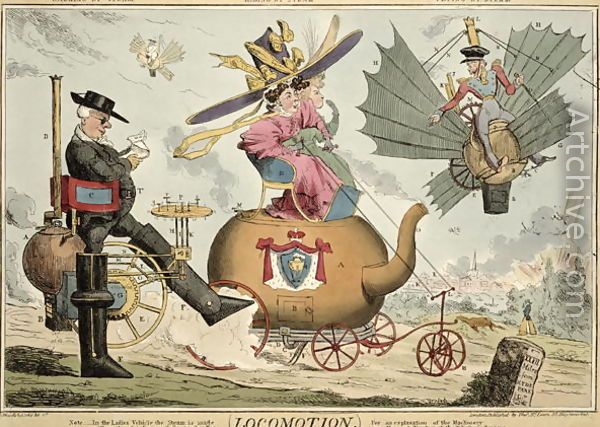
The origins of what has come to be known as The Golden Age of children's book illustration can be traced back to the work of George Cruikshank, now recognized as the first artist to set a standard and form in children's book illustration. Working in the early part of the 19the century, he laid the framework for the great flowering of the illustrator's art that began in the mid-19th century.
George Cruikshank
With these illustrators, nursery rhymes, fairy tales, animal stories and children's picture books entered upon a new and 'modern' era of artistic refinement.
W. Heath Robinson
The last years of the 19th century saw a great awakening of interest in folk tales from all parts of the world. The revival in the appreciation of old fairy tales and children's stories coincided with the threat to traditional cultures posed by the advance of he industrial world. The incredible wealth of talent contributing to book illustration resulted in innumerable fine drawings and paintings combining fantasy, humor and sheer beauty. The array of illustrated book cover designs from the era, richly adorned and gilded, have never been equaled.
Edmund Dulac
Although the overall quality of book production never recovered its former grandeur
after the First World War, Arthur Rackham and many of his younger contemporaries helped to sustain the Golden Age during the 1920s and 1930s.
Arthur Rackham
The death of Rackham and the appearance of his last illustrated book,
The Wind in the Willows coincided with the Start of the Second World War, which
marked the final end of the Golden Age.
-The Golden Age of Children's Book Illustration by Richard Dalby-
* Sun Uranus Mars conjunct in Virgo, Saturn in Cancer conjunct Ascendant, Sag Moon*
Mary was the daughter of two social reformers ahead of their time. She was an English novelist, short story writer, dramatist, essayist, biographer, and travel writer, best known for her Gothic novel Frankenstein: or, The Modern Prometheus (1818).
Her father, William Godwin, was a celebrated political philosopher and historian
who had briefly been a Calvinist minister. A cold, remote man, he had little time for anything but his philosophical endeavors.
Her mother was the philosopher and feminist Mary Wollstonecraft who sadly died from fever only 11 days after Mary's birth.
Her father was left to care for Shelley and her older half-sister Fanny.
He father later married Mary Jane Clairmont,
who proved to be a cruel, shallow woman who
neglected Fanny and Mary
in favor of her own children.
Mary (who was so
lively that her father had nicknamed her Mercury) was frequently whipped
for impertinence; rebellion came naturally to the headstrong Mary, and
she refused to be subdued. Though the girls were given lessons in
domesticity (cooking, cleaning, and other wifely duties) Mary could not pretend interest in such pursuits: she would simply take up a book and let
the dinner burn. (Sag moon)
Her father was the most important person in her life,
and his favor meant everything to her. (Saturn in Cancer, conjunct ascendant). She excelled in her lessons and
could hold her own in adult conversation often with the great minds of
her time from a remarkably early age.
Around the age of eight, she began
reading the writings of her mother. By the time she was ten, she had
memorized every word.
From an early age, Mary was encouraged by her father to write letters
and she took an early liking to writing. She was also encouraged to
embrace her father's sociopolitical liberal views and theories and was
mostly informally educated, at home.
While she didn't have a formal education,
she did make great use of her
father's extensive library. Shelley could often be found reading,
sometimes by her mother's grave.
She also liked to daydream, escaping
from her often challenging
home life into her imagination.
Mary spent hours at her mother's grave,
reading or eating meals when
the
atmosphere at home was particularly bad.
She was later sent to stay with William Baxter, a known radical, and his
family in Scotland. (lucky)
At the age of fifteen, she was described by her
father as
"singularly bold,
somewhat imperious, and active of mind. (Virgo Sun, Sag Moon)
Her
desire of knowledge is great, and her perseverance in everything she
undertakes
almost invincible."
Living with the Baxters was the happiest
time that
Mary had known.
When she returned to London a year
later, she had grown into a woman. She became closer to her father than
ever before, and the two engaged in constant philosophical debate. This
served, predictably, to augment her stepmother's ill will.
The poet Percy Shelley (one of the greatest lyric poets of the English Romantic age and a writer of delicate beauty) was a devoted follower and friend of William
Godwin's,
and began spending a great deal of time in the Godwin home.
(August 4, 1792 *Sun, Venus, Uranus in Leo opposing Pluto in Leo (irresistibly charming and kinetic), Pisces Moon (a dreamy romantic innocent), Saturn conjunct Taurus Ascendant. Mars, Jupiter, Neptune stellium in late degrees of Libra*
Although he was married, his presence made an immediate impression on
Mary,
who began to read poetry at his inducement. Shelley's genuine
admiration
for the works of Mary's mother
earned him her trust she
invited him to accompany her
on her visits to her mother's grave,
and
the two became
inseparable.
Their intellectual kinship was passionately
felt by both of them,
and they rapidly fell in love
(she was 17 and he was married).
Godwin was furious
at this development, and immediately barred the poet from his home.
The
couple, however, refused to be separated and began a clandestine
correspondence.
With the help of Mary's stepsister, they were able to
elope.
Setting up housekeeping in London was expensive,
and money
was very tight for the newly married pair.
Relations between them were
somewhat strained:
Shelley's first wife Harriet belatedly bore him a
son, and his good friend Thomas Hogg became enamored of Mary, and Percy seemed to want
Mary Shelley to have an affair with his friend.
Percy was constantly leaving home, escaping from creditors and also at
the time Harriet gave birth to their son.
To make
matters worse, Mary became pregnant;
the child, a daughter, died shortly
after birth.
Mary fell into an acute depression.
Having conceived
a dislike for London (perhaps as a result of their misfortunes),
the
couple began traveling: in the English countryside, in France, and
elsewhere.
Mary was writing profusely.
They left to Geneva
with Mary's step sister Claire Clairmont in 1816, to spend the summer with Lord Byron, Claire's affair at the time. The bad weather confined them to the house
and they spend much of their time talking about galvanism and reading
ghost stories which prompted her to write the first sketch of what was
to become her most famous novel Frankenstein: or The Modern Prometheus.
Percey Bysshe Shelley
Haunted Summer, a movie telling of the Shelleys, Lord Byron and the making of the monster story.
Later
that year, Mary suffered the loss of her half-sister Fanny who
committed suicide.
Another suicide, this time by Percy's wife,
occurred a
short time later.
Mary and Percy Shelly were finally able to wed in
December 1816. She published a travelogue of their escape to Europe, History of a Six Weeks' Tour (1817), while continuing to work on her soon-to-famous monster tale. In 1818, Frankenstein, or the Modern Prometheus debuted as a new novel from an anonymous author. Many thought that
Percy Bysshe Shelley had written it since he penned its introduction. The book proved to be a huge success. That same year, the Shelleys moved to Italy.
And here is Ken Russell's insane take on the Mary Shelley/Frankenstein myth.
The Shelleys, Claire Clairmont and her new baby Alba,
daughter of Lord
Byron,
moved to a large building on the river Thames.
Here Shelley gave
birth to Clara, her third child.
In the same year, once more afraid of
creditors, they all left to Italy without intention of ever returning.
After leaving Alba with Lord Byron, who agreed to raise her with the
condition that her mother would have nothing more to do with her, the
group wandered around Italy,
socializing, writing, and accumulating
friends that would often travel with them.
The lightness of their
existence came to an end with the death of Shelley's two children in
1818 and 1819 which left her devastated and alienated from her husband.
While Mary seemed devoted to her husband, she did not
have the easiest marriage. Their union was riddled with adultery and
heartache, including the death of two more of their children. Born in
1819, their son, Percy Florence, was the only child to live to
adulthood. Mary's life was rocked by another tragedy in 1822 when her
husband Percy Shelley and a friend, were out boating on the Gulf of
Spezia in Viareggio, Italy. Suddenly a storm arose, during which they were run down by a larger vessel. Their yacht was
overturned during the violent storm and Shelley died.
Made a widow at age 24,
Mary Shelley worked hard to support herself and her son.
She wrote, "For eight years I communicated, with unlimited freedom, with
one whose genius far transcending mine awakened and guided my
thoughts.... Now I am alone - oh, how alone! The stars may behold my
tears and the winds drink my sighs; but my thoughts are a sealed
treasure, which I can confide to none. O my beloved Shelley!"
She wrote several more novels, including Valperga and the science fiction tale The Last Man
(1826). She also devoted herself to promoting her husband's poetry and
preserving his place in literary history. As well Mary Shelley spent much of her time translating poems by Lord Byron. For several years, Shelley
faced some opposition from her late husband's father who had always
disapproved of his son's bohemian lifestyle.
It was roughly a century after her passing that one of her novels, Mathilde, was finally released in the 1950s. Her lasting legacy, however, remains the classic tale of Frankenstein. This struggle between a monster and its creator has been an enduring part of popular culture.
Mary Shelley's most famous novel, Frankenstein: or The Modern Prometheus,
was released anonymously when she was only 21 years old. Only from its
second edition, five years later, was her name to appear as the author.
It was initially thought that the author was her husband Percy, as the
book was dedicated to William Godwin, his political hero. The work came
out of a competition proposed by Lord Byron in the summer of 1816: who could write the best horror story.
The central idea came to Shelly
in a dream where she saw a student putting together parts of a man's
body and working through a big engine to animate it. She first wrote a
short story but Percy encouraged her to expand it into a novel. The
novel had at the center of its plot a failed attempt at artificial life,
by the scientist Frankenstein, which produced a monster.
The work is
considered to be a mixture of science fiction, gothic novel, and having
elements from the Romantic movement. It was partly inspired by the
electrical experiments conducted on dead and living animals by the Italian physicist Giovanni Aldini. Frankenstein: or The Modern Prometheus
is also seen as a warning about the transformations of man under the
Industrial Revolution.
In what is the chronological end of the novel's
story, even if the scene belongs to the beginning of the book;
Frankenstein warns about the terrible effects of letting oneself be
driven by ambition and losing control over its own possibilities.
No one could have predicted the extent of the book's popularity:
it would remain the most widely-read English novel for three decades.
Although it was maliciously rumored that Percy Shelley was the book's
true author, Mary was catapulted to the forefront of the struggle for
recognition then being waged by woman writers.
Shelley died of brain cancer on February 1, 1851, in London, England.
She was buried at St. Peter's Church in Bournemouth, laid to rest
alongside her father and mother and with the cremated remains of her
late husband's heart.
he was a British occultist, mystic, poet, and social provocateur.
He was a pansexual mystic,
occultist, ceremonial magician, deviant, recreational drug experimenter,
poet and accomplished mountaineer. He founded the religious philosophy
of Thelema which enforced an idealist, libertine rule of
“Do what thou
wilt.”
The British press named him “The Wickedest Man in the World.”
Crowley is responsible for the modern day
popularity with the occult.
He inherited his father’s
brewing wealth and attended Cambridge University.
In 1898, at the age 23 he joined the clandestine organization, The Hermetic Order of the Golden Dawn, thus beginning his long love affair with mysticism
and the occult. However, his affiliation didn’t last long as he frequently offended the elder members of the group, famously aggravating
well known poet William Butler Yeats.
Crowley identified himself as a Freemason, and followed the
teachings which were based on the Kabbalah, astrology, tarot and
geomancy.
Golden Dawn temples were established in London, Scotland, and
Paris.
In 1899 he bought the Boleskine House on the shores of
Loch Ness in Scotland (you know... where the Loch Ness monster lives).
The Boleskine house
had all of the properties that Crowley found necessary to perform magick
rituals because it is a focal point of energy due to where it is sited.
Crowley bore a heavy influence on many musicians including Jimmy
Page.
Page bought his former residence in Scotland, because of his fondness of Crowley and the
occult.
People believe that Crowley never properly grounded his rituals and the spirits are still roaming about the house.
Jimmy Page at Boleskine House
Crowley was a prominent
member of the Ordo Templi Orientis (OTO), and shortly after buying the Boleskine
estate, Crowley and his wife spent time doing rituals in Egypt,
believing they communicated directly with the Egyptian god Horus.
Crowley believed that Horus
wanted him to be a prophet to inform the human race of the entrance into the Aeon of Horus era, ushering in the 20th
century.
The religion Crowley created, Thelema, says human history can be divided into eras of
different magical and religious expressions.
The first era was the Aeon
of Isis (goddess worship); the second was Aeon of Osiris (medieval times with male god worship), and the third is the Aeon of
Horus (modern time with child god worship).
After more successful rituals all
over the world, Crowley created yet another magical order called the
Argenteum Astrum and proceeded to write
books for the remainder of his life.
Crowley did his “duty” of ushering in this new era as the Aeon of Horus,
and his influence is easily seen in the entertainment industry. Crowley’s message influenced rock mega stars
such as David Bowie, the Rolling Stones, Ozzy Osbourne, the Beatles, the Doors and Led Zeppelin.
The back of a Doors album
Aleister Crowley and David Bowie
Crowley studied Philosophy at Cambridge and later switched to English
literature.
He believed he had a guardian angel, Aiwass and
believed that he was being guided by him.
Crowley was depicted on the cover of The Beatles’ Sergeant Pepper’s Lonely Hearts Club Band.
Crowley also enjoyed
mountaineering. He rather exuberantly scaled K2 and Kanchenjunga, the 2nd and 3rd highest
mountains in the world.
He died penniless and alone.
Although the actual dates of Crowley’s death are heavily disputed
(Dec 1st or 5th) it is true that he died a heroin addict in
1947 in a boarding house in Hastings, South East England.